
Last Updated: November 8, 2026
Quick Summary
The best healthy stir fry sauces keep sugar at 2g or less and sodium under 300mg per 2 tbsp serving, with no canola or soybean oil. A three-ingredient homemade version using tamari, vinegar, and honey takes about five minutes and costs less than a bottle. For store-bought, check the serving size first, since labels often list one tablespoon when you would use three.
- Skip bottled sauces listing canola or soybean oil, since these are cheap fillers that add calories without flavor.
- Scale the base tamari-vinegar-honey sauce 4x to make about 3/4 cup, keeping it refrigerated up to two weeks.
- Add grated garlic and ginger fresh to the wok rather than scaling them into a batch, as they lose their bite within days.
- Freeze the base and black-pepper sauces in two-tablespoon portions for about three months; skip freezing citrus or lemongrass versions.
- Cook plant-based protein and vegetables first, then add sauce in the last minute so it stays bright.
Table of Contents
- What Makes a Stir-Fry Sauce Healthy?
- The 3 Ingredient Stir-Fry Sauce You Can Make at Home
- MOB Asian Sauce Bundle: Low-Sugar Stir-Fry Sauces
- MOB Sesame Satay Sauce: Nut-Free Creaminess for Grills and Bowls
- MOB Coconut Yellow Curry and Sweet Chili Lemongrass: Two Soy-Free-Friendly Finishers
- Best Healthy Sauces for Stir Fry Vegetarian and Plant-Based Cooking
- Low Calorie Stir-Fry Sauce to Buy: What to Check on the Label
- The Healthiest Stir-Fry Sauce to Buy for Allergies and Clean Labels
- Frequently Asked Questions
What Makes a Stir-Fry Sauce Healthy?
Healthy stir fry sauces are built on whole-food ingredients, with low sugar, controlled sodium, and no industrial seed oils.
Reading competitor labels, the pattern is often consistent: sugar in the first three ingredients, high sodium per pour, and canola or soy oil as a cheap filler.
Here is the short version of what to watch:
- Sugar: aim for 2g or less per 2 tbsp serving. Anything above 6g is dessert, not dinner.
- Sodium: under 300mg per serving keeps you in a reasonable range, especially if you also use soy sauce or tamari.
- Oils: skip canola and soybean oil. Toasted sesame oil brings flavor; canola brings volume.
The FDA guidance on reading Nutrition Facts labels is a useful primer if you want to decode serving sizes and added sugars properly.
Sugar, Sodium, and the Oils to Skip
Sugar is the first thing to check, because it hides behind names like cane syrup, maltodextrin, and fruit juice concentrate.
Sodium is trickier. Soy sauce and tamari are salty by nature, so a sauce that adds salt on top doubles up.
Canola oil is the quiet one. It appears in a huge share of shelf-stable sauces because it is cheap and neutral.
The 3 Ingredient Stir-Fry Sauce You Can Make at Home
A three-ingredient stir-fry sauce takes about five minutes and costs less than a bottle. The base formula is a savory liquid, an acid, and a sweetener, balanced to taste. The useful part is knowing how to move from that formula to distinct sauce profiles, and how to scale and freeze them.
Here is the base version we would start anyone on:
- 3 tbsp low-sodium tamari or soy sauce for the savory base
- 1 tbsp rice vinegar or apple cider vinegar for tang
- 1 tsp honey or a natural sweetener to round it out
Whisk, taste, and adjust. If it tastes flat, add more vinegar; if harsh, thin with water or low-sodium vegetable broth. A few drops of toasted sesame oil at the end add roasted depth.
For a thicker sauce, whisk in a teaspoon of cornstarch mixed with cold water before it hits the pan. Add fresh garlic and ginger to the wok first, then pour the sauce in at the end so the garlic does not burn.
Four regional profiles from the same three-part formula
The base formula is a template, not a single flavor. Change the acid, aromatic, and sweetener and you get distinct regional profiles.
- Ginger-scallion (Cantonese-style): keep the tamari base, swap vinegar for a splash of Shaoxing wine or dry sherry, and load in grated ginger and sliced scallion. Skip the honey or use a quarter teaspoon. Add in the last thirty seconds so the scallion stays green.
- Coconut-lemongrass (Thai-inspired): coconut aminos or light soy as the base, lime juice as the acid, and a teaspoon of palm sugar or honey. Add a bruised lemongrass stalk and a few lime leaves while the sauce warms. Suits tofu, shrimp, and chicken.
- Black pepper (Sichuan-leaning): tamari base, black vinegar or rice vinegar, and a small amount of sugar. The defining move is freshly cracked black pepper off the heat, plus a pinch of ground white pepper. Stands up to beef and mushrooms.
Watch out: black vinegar and coconut aminos both taste less salty than tamari, so taste before you add extra salt.
Batch scaling that actually holds up
The base formula scales linearly, but aromatics and thickeners do not.
- Base sauce (tamari, vinegar, honey): scale 4x to make about 3/4 cup, covering four to six stir-fries. Keep in a sealed jar in the refrigerator up to two weeks; shake before each use because the honey settles.
- Aromatics (garlic, ginger, scallion): do not scale these into a long-kept batch. Grated garlic and ginger lose their bite within days in liquid. Add them fresh to the wok.
- Cornstarch slurry: make it fresh each time. A pre-mixed slurry settles into a hard block.
Freezing and thawing
Freezing works well for the base sauce and the black-pepper profile, and less well for anything with fresh citrus or lemongrass.
- What freezes well: the tamari-vinegar-honey base and the black-pepper sauce. Freeze in two-tablespoon portions in an ice cube tray, then transfer to a freezer bag; they keep about three months.
- What does not freeze well: coconut-lemongrass and citrus-plum. The fresh juice separates and the lemongrass turns dull. Make these fresh or refrigerate up to a week.
- Thawing: drop cubes straight into a hot wok at the end of cooking; they melt in under a minute. For a cold use like a dressing, thaw overnight in the refrigerator and shake well.
Once you know the formula, you can swap the acid for lime, the sweetener for pineapple juice, or the tamari for coconut aminos. That is how you get from one sauce to a dozen without buying a dozen bottles.
MOB Asian Sauce Bundle: Low-Sugar Stir-Fry Sauces
If you want the flavor range of a sauce collection without the sugar load of a typical supermarket bottle, the Asian Sauce Bundle is our pick for most kitchens.
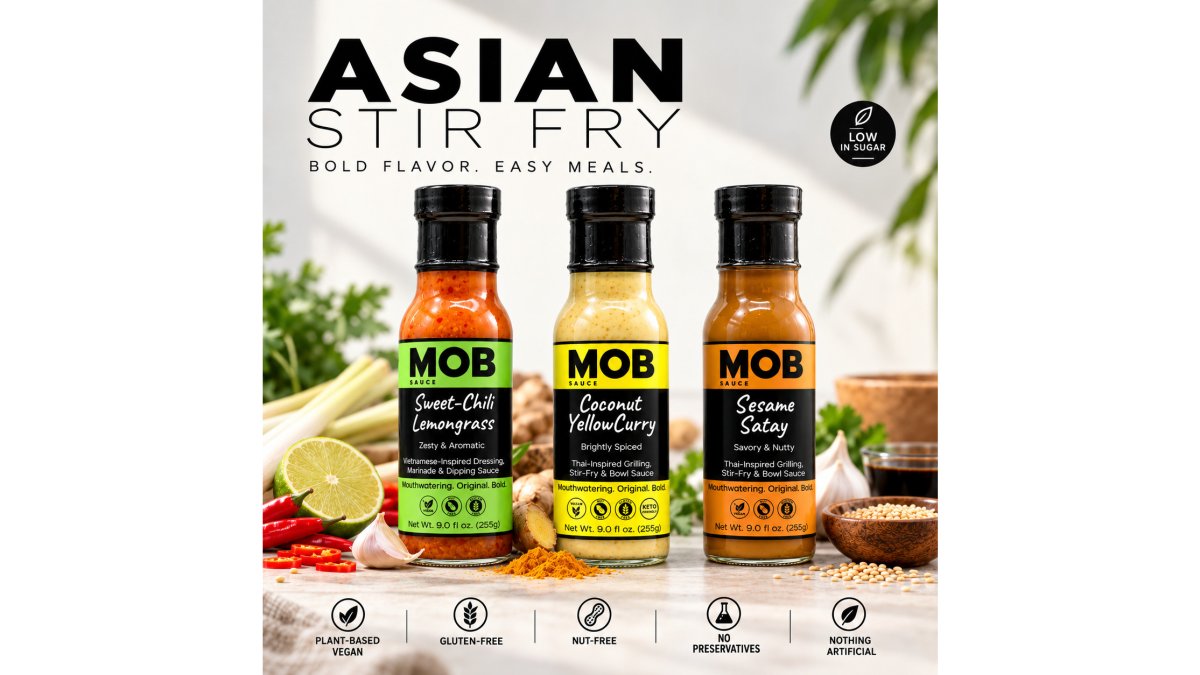
The bundle is plant-based, made without dairy or egg, and hand-filled in small batches.

Use it as a dressing, marinade, or dipping sauce. You can shop the low-sugar stir-fry trio directly.
Best for: families cooking stir-fry several nights a week who want one bundle that covers marinades, dressings, and finishing sauces. Skip if: you need a fully sugar-free bottle.
MOB Sesame Satay Sauce: Nut-Free Creaminess for Grills and Bowls
Nut-free creamy sauces can be hard to find, and this one is nut-free.
It is certified gluten-free, plant-based, and made without soy oil or canola oil. One caveat: it does contain soy from tamari, so it is not a soy-free option.
How we use it: finish a stir-fry right before serving, thin with water or rice vinegar for a dressing, or use as a marinade and baste for chicken, steak, or pork. If you are cooking for a household with a nut allergy, you can see the nut-free sesame satay sauce and check the full ingredient list before you buy.

Best for: households managing a nut allergy who still want a satay-style sauce. Skip if: you are avoiding soy.
MOB Coconut Yellow Curry and Sweet Chili Lemongrass: Two Soy-Free-Friendly Finishers
Soy is a common concern for some gluten-free and nut-free cooks. These two sauces suit different needs and behave differently in the pan.
The Coconut Yellow Curry is our most popular Asian flavor: Thai-inspired, lime-forward, and not spicy. You can view the coconut yellow curry sauce for full details.

The Sweet Chili Lemongrass is Vietnamese-inspired, zesty and bright with fresh lemongrass, shallots, and garlic. It does contain soy, so pair it with the curry if your household is split. See the sweet chili lemongrass sauce if that profile sounds right.
Best for: cooks who need to cover both soy-free and soy-friendly diets in one household. Skip if: you want one bottle to do everything.
Best Healthy Sauces for Stir Fry Vegetarian and Plant-Based Cooking
Plant-based stir-fry relies on the sauce for much of its flavor. Every sauce in our range is 100% plant-based with no dairy or egg.
The flavor pairing that matters most is matching sauce to protein:
| Protein | Sauce to reach for | Why it works |
|---|---|---|
| Firm or extra-firm tofu | Sesame Satay | The creamy tahini coats tofu cubes and helps them brown |
| Tempeh | Coconut Yellow Curry | Lime-forward curry cuts through tempeh's earthiness |
| Seitan | Sweet Chili Lemongrass | The vinaigrette texture keeps dense seitan from feeling heavy |
| Chickpeas | Asian Sauce Bundle | Low-sugar base works with starchy legumes |
| Mushrooms | Coconut Yellow Curry | Umami plus lime keeps mushrooms from tasting flat |
A common mistake is pouring sauce in at the start. For plant-based stir-fry, cook the protein and vegetables first, get some color on them, then add sauce in the last minute. Adding the sauce at the end also lets the mushrooms’ texture come through, whether you choose oyster or shiitake, a distinction FARMY Organics explores.
Low Calorie Stir-Fry Sauce to Buy: What to Check on the Label
Healthy stir fry sauces that are low in calories get them from real ingredients rather than oil and sugar fillers. Most of the calorie load in a bottled sauce is oil and sweetener, so a clean label usually means a lighter pour.
The four numbers that matter, side by side
When you compare two bottles, line up these four figures per two-tablespoon serving. The differences are usually larger than the front label suggests.
| What to compare | Target range | Why it matters |
|---|---|---|
| Calories per 2 tbsp | 30-60 kcal | Oil and sugar are the main calorie drivers; a sauce above 80 kcal per serving is usually oil-heavy |
| Sugar per 2 tbsp | 2g or less | Above 6g per serving, the sauce is closer to a glaze or dessert |
| Sodium per 2 tbsp | Under 300mg | Soy sauce and tamari are salty by nature, so a sauce that also adds salt doubles up |
| Fat per 2 tbsp | Lower fat is generally preferable, from sesame or olive oil | Canola and soybean oil are cheap fillers that add calories without flavor |
A common pattern is that a bottle advertising "low sugar" on the front may still carry more sugar per serving once you read the panel, because the listed serving size is smaller than the amount you would actually use.
Store-bought categories, compared by label
If you do not want to cook a sauce, the store-bought aisle splits into a few recognizable categories. Each has a different label profile, and the differences are worth knowing before you buy.
- Standard teriyaki and stir-fry bottles: often carry higher sugar and sodium. Many list sugar or corn syrup among the first ingredients.
- Reduced-sodium soy-based sauces: lower in sodium, but sugar can stay high to balance the salt. Check both numbers.
- Coconut-aminos-based bottles: naturally soy-free and lower in sodium, but they vary widely in sugar and often rely on fruit juice concentrate.
Watch out: "no added sugar" does not mean low sugar. Fruit juice concentrate, maltodextrin, and cane syrup are all added sugars under different names, and the Nutrition Facts panel is the only place that totals them.
A quick label-reading order
Read the panel in this order so you do not get distracted by front-label claims:
- Serving size: convert to the two tablespoons you will actually use
- Sugar per serving: 2g or less per 2 tbsp is the target
- Sodium per serving: under 300mg per 2 tbsp
If you want to go deeper on sugar-free options specifically, our guide to sugar-free sauce without artificial sweeteners walks through what to look for and what to avoid.
The USDA FoodData Central database is a free way to check the nutrition profile of individual ingredients if you are building your own sauce and want to compare. The FDA guidance on reading Nutrition Facts labels explains how serving sizes and added sugars are defined, which is the part most shoppers skip.
The Healthiest Stir-Fry Sauce to Buy for Allergies and Clean Labels
For allergy households, the healthiest stir-fry sauce is the one whose label you can actually verify.
This is the standard we hold ourselves to at MOB Sauce.
"Clean label" is not a formally defined term, so the wording alone does not guarantee much.
One more honest limitation: our sauces are not all soy-free.
Stir-fry night should not require a chemistry degree or a compromise on flavor.
Frequently Asked Questions
What is the healthiest sauce for stir fry?
The healthiest stir-fry sauce is one with low added sugar, moderate sodium, and no canola or soybean oil. Look for 2g of sugar or less per 2-tablespoon serving and a clean ingredient list you can pronounce. A homemade three-ingredient mix of tamari, rice vinegar, and a little honey works well, and small-batch bottled options like MOB's low-sugar Asian bundle give you the same clean profile without the prep work.
Is there a healthy pre-made stir-fry sauce available?
Yes. Pre-made sauces can be healthy if you check the label for added sugar, artificial sweeteners, and refined oils. MOB Sauce makes several options: the Coconut Yellow Curry and Sweet Chili Lemongrass both list 2g of sugar per 2 tablespoons, and the Asian Sauce Bundle is certified gluten-free and nut-free. All are plant-based, made without canola oil, and hand-filled in small batches so you get whole-food ingredients rather than fillers.
What can I use instead of soy sauce in stir-fry?
Coconut aminos and tamari are the two most common swaps. Tamari is a gluten-free soy sauce, so it still contains soy but works for gluten-free diets. Coconut aminos are soy-free and slightly sweeter. If you avoid soy entirely, MOB's Coconut Yellow Curry is soy-free and adds a lime-forward Thai flavor without any soy sauce at all. For a homemade version, mix coconut aminos with rice vinegar and a pinch of garlic.
How do I make a low-calorie stir-fry sauce?
Start with a low-sodium broth or water as your base, then add rice vinegar, fresh garlic, and ginger for flavor without calories. Skip cornstarch and thick syrups, which add sugar and bulk. A splash of sesame oil at the end gives richness with very little volume. If you buy bottled, check that the first ingredients are broth, vinegar, or tamari rather than sugar or corn syrup, and keep portions to 2 tablespoons.
Do MOB sauces work for someone who is gluten-free and nut-free?
Yes. Every MOB sauce is certified gluten-free through the Gluten-Free Food Program and certified nut-free, including the Sesame Satay, which uses tahini and toasted sesame oil for its creamy texture instead of peanuts. The Asian Sauce Bundle and the Global Sauce Bundle are both plant-based and free from dairy and egg. If you also avoid soy, the Coconut Yellow Curry is the one sauce in the range listed as soy-free.

