
Quick Summary
To learn how to read food labels for additives, start with the ingredient list, since items are ordered by weight, and check the first three ingredients for sugar, thickeners, or synonyms. Then decode E-numbers and chemical names, such as dextrose or xanthan gum, to see what each additive does.
- Ingredients are listed by weight, so check the first three for sugar or thickeners.
- Words ending in "-ose", syrups, and fruit juice concentrates all add hidden sugar.
- E-numbers are classification codes; the hundreds digit indicates the additive's function.
- Multiply the nutrition panel numbers by the amount you actually pour, not the listed serving size.
- Read the allergen line every time, since recipes can change between purchases.
Table of Contents
- Start With the Ingredient List: Order Tells the Story
- Decoding E-Numbers and Chemical Synonyms
- How to Spot Hidden Sugars in Ingredients
- Reading the Nutrition Facts Panel and %DV
- Marketing Buzzwords vs. Regulated Terms
- Checking Allergens and Dates on Sauce Bottles
- Picking Clean Eating Sauces for Busy Parents
- Frequently Asked Questions
Why Additives Hide in Plain Sight on Sauce Labels
Most people assume that a sauce labeled "natural" or "clean" is free of additives. Often it is not.
Additives hide in plain sight for a simple reason. Labels are legally required to list ingredients, but the names are often technical.
Common reasons additives appear in sauces:
- To keep flavor stable over a long shelf life
- To thicken the sauce without cooking it down
- To boost sweetness without adding much sugar by name
Knowing this helps you read with purpose. You are not looking for one bad word. You are looking for patterns that signal a heavily processed product.
Start With the Ingredient List: Order Tells the Story
The ingredient list runs in order of weight, from the most used ingredient to the least. Start here before you look at anything else on the label.
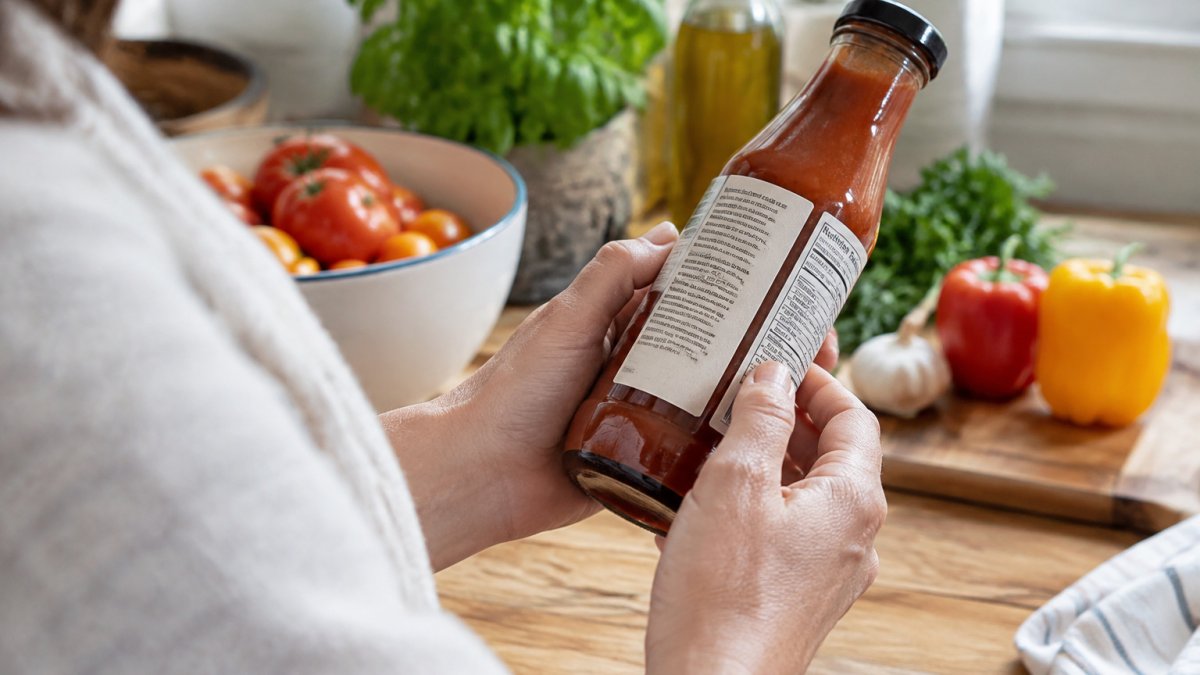
Hold the bottle under a good light and use how to read food labels for additives to check the first three ingredients. Those make up most of the sauce. A clean sauce usually starts with vegetables, herbs, vinegar, or oil, not with syrup or starch.
Quick checks for the top of the list:
- Is the first ingredient a whole food like tomato, garlic, or vinegar?
- Does sugar or a syrup appear in the top three?
- Is a thickener like modified starch or gum near the front?
Watch out: a sauce can list "cane sugar" and "fruit juice concentrate" separately to push each one lower on the list. Add them together to see the real sugar load.
Decoding E-Numbers and Chemical Synonyms
In many markets, approved additives carry an E-number. The number is not a warning label; it is a classification code, and the hundreds digit generally indicates the additive's function. Once you know the ranges, a long ingredient list becomes easier to scan because you can sort each code by the job it does.
You do not need to memorize the full register. A working set of sauce-specific additives is enough for most shopping trips.
Preservatives (E200-E299)
- E202 (potassium sorbate): slows mold and yeast growth in acidic products such as ketchup, dressings, and fruit-based sauces.
- E211 (sodium benzoate): works in acidic conditions and is common in soft drinks, pickles, and condiments. It is often paired with E202 for a broader preservative effect.
- E260 (acetic acid): the active component of vinegar, used as both a preservative and a flavor agent.
Thickeners, Stabilizers, and Emulsifiers (E400-E499)
- E415 (xanthan gum): a fermentation-derived polysaccharide that thickens and keeps oil and water from separating. It is common in gluten-free sauces because it mimics some of the body gluten would provide.
- E412 (guar gum): a plant-derived thickener often used in dressings and sauces.
- E407 (carrageenan): a seaweed-derived thickener and stabilizer; some shoppers choose to avoid it, though it is approved for use in most markets.
- E471 (mono- and diglycerides of fatty acids): an emulsifier that blends oil and water and improves texture.
Antioxidants and Acidity Regulators (E300-E399)
- E330 (citric acid): the most common acidity regulator; it adjusts pH and adds a bright, tart note.
- E300 (ascorbic acid): vitamin C used as an antioxidant to slow browning and oxidation.
- E385 (calcium disodium EDTA): a chelating agent that binds trace metals and helps preserve color and flavor.
Colors (E100-E199)
- E160a (carotenes): natural pigments from plants, often used to give sauces a warm orange or yellow tone.
- E150d (sulfite ammonia caramel): a brown color common in dark sauces; it is one of the caramel classes that sometimes carries a sulfite declaration.
Seeing an E-number is not automatically a red flag. Many carefully made products use them, and the code simply tells you what the additive does. The point is to read with recognition rather than alarm.
Chemical Names That Mean Sugar, Salt, or Oil
Additives are not the only ingredients that hide behind technical names. Sugar, salt, and fat appear under many synonyms, and recognizing them is part of reading the list accurately.
- Sugar synonyms: dextrose, maltodextrin, corn syrup, high-fructose corn syrup, glucose syrup, invert sugar, agave nectar, fruit juice concentrate, rice syrup, and any word ending in "-ose" (fructose, sucrose, maltose).
- Salt synonyms: sodium chloride, sodium benzoate, sodium citrate, monosodium glutamate (MSG), sodium nitrite, and any ingredient with "sodium" in the name.
- Oil synonyms: canola oil, soybean oil, sunflower oil, palm oil, palm kernel oil, and the generic term "vegetable oil," which can hide a blend.
If you avoid a specific oil or additive, scan for its exact name and for the generic terms that can conceal it.
Watch out: some additives are declared under both an E-number and a chemical name in different markets, so the same product sold in two countries can look different on the label even when the formulation is identical.
How to Spot Hidden Sugars in Ingredients
Sugar is the most common hidden additive in sauces. A label can say "no added sugar" while still relying on fruit concentrates or sweet vegetables for a strong sweetness.
Look for any word ending in "-ose" (such as dextrose or fructose), any syrup, and any concentrate. Each one adds sweetness, even if it is not called sugar.
Here is a simple way to check:
| Hidden Sugar Name | What It Is | Where It Often Appears |
|---|---|---|
| Dextrose | Simple sugar from corn | Dressings and marinades |
| Maltodextrin | Starch broken into sugars | Thickened sauces |
| Fruit juice concentrate | Sugar from fruit | Sweet and tangy sauces |
| Agave nectar | Sweet syrup | Glazes and dips |
Once you spot these, you can judge how sweet the sauce really is before you buy.
Reading the Nutrition Facts Panel and %DV
The Nutrition Facts panel gives numbers for one serving, and the serving size is listed first. Every number below it applies only to that amount.
Percent Daily Value, or %DV, shows how much one serving contributes to a full day's diet based on a 2,000-calorie reference. The practical thresholds are simple: 5% or less is low, and 20% or more is high.
MOB Fry Sauce- Tangy Medium Heat →
The Lines That Matter Most for Additive-Heavy Sauces
- Added Sugars: this line separates sugars that occur naturally in ingredients like tomatoes from sugars added during manufacturing. A sauce with 0 g total sugars but a high added-sugars line is telling you the sweetness was formulated in.
- Sodium: sauces are a major hidden sodium source. A single tablespoon can carry 10-20% of the daily value, and it is easy to use several tablespoons in one meal.
- Saturated Fat: check this line if the sauce is oil-based; a creamy or emulsified sauce can carry a meaningful share of the daily value per serving.
- Fiber and Protein: these are less relevant for condiments, but they help you judge whether a sauce contributes anything beyond flavor.
A Worked Comparison
Imagine two tomato-based sauces. Sauce A lists 4 g of added sugars and 180 mg of sodium per tablespoon; Sauce B lists 1 g of added sugars and 90 mg of sodium per tablespoon. On the %DV scale, Sauce A delivers roughly 8% of the daily added-sugar limit and about 8% of the sodium limit per tablespoon, while Sauce B delivers about 2% and 4%.
Watch out: the serving size on a sauce bottle is often one tablespoon, but most people pour two to four. Multiply every number by the amount you actually use before you judge whether the sauce fits your day.
Reading the Panel Alongside the Ingredient List
The panel and the ingredient list answer different questions. The panel tells you how much sugar, sodium, and fat the product contains; the ingredient list tells you where those numbers come from.
For shoppers managing a specific limit, the most useful habit is to set a personal ceiling before you shop, for example, no more than 5% DV of added sugars and 10% DV of sodium per serving, and then compare sauces against that ceiling rather than against each other.
Marketing Buzzwords vs. Regulated Terms
Front labels use words that sound precise but often are not. Terms like "all natural," "clean," or "wholesome" have no single legal definition in many markets.
Examples of regulated claims include "low sodium," "sugar-free," and "gluten-free." Each has a defined threshold or testing requirement.
A helpful habit: when you see a buzzword, check the ingredient list to confirm it. The list is more reliable than the slogan.
Checking Allergens and Dates on Sauce Bottles
Allergens must be declared on the label, often in bold or in a separate "Contains" line. Read this line every time, even for products you have bought before, because recipes change.
Dates matter for safety and quality. Look for "best before" and "use by" dates.
After opening, check the storage instructions. Many sauces with fewer preservatives need refrigeration once opened, so follow that guidance closely.
Picking Clean Eating Sauces for Busy Parents
Parents managing busy schedules and dietary limits need a quick way to shop. These label checks can also sharpen your eye for spotting hidden toxic ingredients in the everyday products you bring home.
When you find a sauce that passes these checks, it is a strong candidate for everyday meals. You can browse the full range of sauces to compare options that fit your household's needs.

Reading labels takes a few minutes at first. With practice, it becomes a quick habit that tells you exactly what goes on your family's plate.
Frequently Asked Questions
What is an additive on a food label?
An additive is any ingredient added for a technical purpose, such as preserving, thickening, sweetening, or preventing separation. Additives are listed by name or by E-number in the ingredient list.
How do I find hidden sugar in sauce?
Scan the full ingredient list for words ending in "-ose," any syrup, and any fruit juice concentrate. These all add sweetness even when the label does not say "sugar."
Are E-numbers always harmful?
No. E-numbers are codes for approved additives. Many are used safely in carefully made foods. The number tells you what the additive is, so you can decide whether it fits your preferences.
Frequently Asked Questions
How do I read the ingredients on food labels?
Ingredients are listed by weight, from most to least. Start with the first three to five items, since they make up most of the product. Look for sugar under its many names, such as dextrose, maltose, or cane syrup. Watch for long lists of ingredients you cannot pronounce, and note whether the sauce uses canola or soybean oil, which are common in conventional sauces. If an ingredient appears more than once under different names, the total sugar or oil content is higher than it first looks.
What %DV is considered high on a nutrition label?
The percent Daily Value (%DV) shows how much one serving contributes to a 2,000-calorie daily diet. As a general guide, 5% DV or less per serving is considered low, and 20% DV or more is considered high. For sodium, added sugars, and saturated fat, aim for low %DV. For fiber, vitamins, and minerals, aim for high %DV. Remember that many sauces are used in small amounts, so check the serving size before judging a product.
Are all food additives harmful to my health?
No. Many additives, such as salt, vinegar, and citric acid, are common kitchen ingredients with no known concern at typical levels. Others are preservatives or emulsifiers that serve a purpose. The practical approach is to notice which additives appear in a product and decide whether they fit your own dietary goals, whether that means avoiding artificial sweeteners, certain oils, or synthetic colors. Individual sensitivities vary, so check with a healthcare professional if you have a specific condition.
How can I identify hidden additives in an ingredient list?
Hidden additives often appear under technical names or E-numbers, such as E211 for sodium benzoate or E951 for aspartame. Look for words ending in -ate, -ide, or -ose, and for items labeled as flavor, spice, or natural flavor, which can contain several substances. Check for preservatives and stabilizers, which extend shelf life. A short ingredient list with recognizable items is usually the easiest way to avoid unnecessary additives.

