
Last Updated: October 28, 2026
Quick Summary
Small batch sauces are worth the cost when their ingredients, allergen controls, and flavor suit how you cook. Compare the price per fluid ounce, then adjust for how much you use per serving. A higher per-ounce price is more reasonable if the sauce is concentrated and used as a finishing sauce.
- Divide the price by net fluid ounces, not total package weight, to compare sauces fairly.
- A per-ounce price within roughly double a supermarket sauce is defensible for finishing use.
- Sugar-free sauces such as the Chilean Chimichurri can go on the grill without scorching.
- Add sauces with sugar or tamari late in cooking to prevent burning.
- Read each label for certifications and allergen statements if you cook for a severe allergy.
Table of Contents
- What Small Batch Sauces Actually Are
- Small Batch Sauce vs. Mass-Produced Sauce
- Why Artisanal Sauces Cost More
- What the Price Buys: Ingredients, Allergen Control and Clean Labels
- Cost Per Ounce: Running the Numbers on MOB Sauce
- Best Small Batch Sauces for Cooking
- How to Store Artisanal Vegan Sauces and Choose Your First Bundle
- Frequently Asked Questions
Small batch sauces cost more than the bottles on a supermarket shelf, and that gap is the first thing most shoppers notice. This guide from MOB Sauce looks at whether the premium is worth paying, what it actually buys, and how to decide for your own kitchen. We keep the focus on what you can verify: ingredients, allergen controls, and the cost of a bottle measured per ounce. Small batch sauces are a fair question for any budget, and the answer depends on how you cook and what you need the sauce to do.
What Small Batch Sauces Actually Are
"Small batch" describes how a sauce is made, not a legal category, so the term carries no fixed standard across brands. In general, it refers to producing sauce in limited runs, often in kitchens that handle one recipe at a time rather than running continuous industrial lines. Smaller runs let a producer taste and adjust each batch before bottling.
At MOB Sauce, that means every bottle is hand-filled and tasted in small batches. The same approach supports quality control, since a problem in one run is easier to catch and isolate. For a buyer, the practical question is simpler: does the label tell you what went in, and does the sauce taste like its ingredients?
Small Batch Sauce vs. Mass-Produced Sauce
The clearest difference between small batch and mass-produced sauce is scale of production, not an automatic difference in quality.
The trade-off shows up in the label. Compare ingredient lists before deciding which differences matter to you.
Why Artisanal Sauces Cost More
Several cost drivers explain the price gap. Smaller runs spread fixed costs over fewer bottles, so each unit carries more overhead. Hand-filling and tasting add labor that a high-speed line avoids. Specialty ingredients such as certified gluten-free components, nut-free production, and canola-oil-free formulations also raise sourcing and testing costs.
What the Price Buys: Ingredients, Allergen Control and Clean Labels
For many buyers, the premium pays for control over what goes into the bottle. MOB Sauce's range is 100% plant-based, vegan, nut-free, and gluten-free certified, with no canola oil and no artificial sweeteners. Several sauces are naturally sugar-free, and the Coconut Yellow Curry Sauce carries only 2 grams of sugar per serving. Those are the specifics the label supports, so they are the claims worth checking against your own needs.
Allergen control is where small-scale production can matter most. A facility that runs nut-free and gluten-free products carefully reduces cross-contact risk, which is a real concern for families managing a severe allergy. If you cook for someone with a diagnosed allergy, read the certification and allergen statements closely rather than relying on general reputation.
Cost Per Ounce: Running the Numbers on MOB Sauce
Price per bottle tells you little on its own, so divide the cost by the volume. A $12.00 bottle of Sweet Chili Lemongrass Sauce and another bottle are not directly comparable until you know how many fluid ounces each contains and how many servings you actually get.
Here is how to run the comparison for any sauce, including MOB's lineup. First, find the net fluid ounces on the label, not the total package weight, which includes the bottle. Second, divide the price by that number. Third, divide again by the number of servings per container if you want a cost-per-use figure. For MOB's Top Rated Sauce Bundle, which includes the Coconut Yellow Curry, Chilean Chimichurri, and Peruvian Verde sauces at $33.00 for three bottles, check each product page for the individual bottle size before you divide. The same applies to the $12.00 Sweet Chili Lemongrass single.
A common pattern in artisan sauce pricing is that the per-ounce cost runs higher than mass-market condiments, but the gap narrows when you account for concentration and use rate. Small batch sauces are often thicker or more intensely flavored, so a tablespoon does the work of two or three tablespoons of a thinner supermarket sauce. That means the effective cost per serving can be closer than the sticker price suggests. The honest trade-off is this: if you use sauce by the cup, pouring it over rice or using it as a base, the per-ounce premium adds up quickly. If you use it as a finishing sauce, a drizzle, or a dip, the premium spreads across many meals. This same principle regarding the value of micro-batch production applies across the culinary spectrum, including the nuanced economics of specialty coffee.
USDA guidance on food label serving sizes is a useful reference for reading serving information on any label, and it helps you compare a 2-tablespoon serving of one sauce against another. To make the math concrete without inventing numbers, do this: write down the price and fluid ounces of your current supermarket sauce, then do the same for the MOB bottle you are considering. Divide both. If the MOB figure is within roughly double the supermarket figure per ounce, and you use it as a finishing sauce rather than a base, the premium is usually defensible. If it is triple or more, you need a specific reason, an allergy, a flavor you cannot find elsewhere, or a dietary restriction, to justify it.
Shop MOB's Top Rated Sauce Bundle if you want to test three sauces at once and run this calculation across a variety of flavors rather than committing to a single bottle.

The article's per-ounce method is easier to scan when the steps are laid out side by side.
| Step | What to do | Note |
|---|---|---|
| Find net volume | Read fluid ounces on the label | Not total package weight |
| Divide price | Price ÷ fluid ounces | Gives cost per ounce |
| Divide by servings | Cost per ounce ÷ servings | Optional cost-per-use figure |
| Compare to supermarket | Within roughly double is defensible | Triple or more needs a specific reason |
| Check bundle bottles | Look up each bottle size | Before dividing the $33.00 bundle |
Best Small Batch Sauces for Cooking
Choose sauces by how you cook, not by name. The difference between a sauce that works as a marinade and one that works as a finishing drizzle comes down to three things: sugar content, acid level, and how the sauce behaves under heat. Small batch sauces often have an advantage here because their ingredient lists are shorter and more transparent, so you can predict how they will react in a pan.
Sugar content is the first variable. A sauce with added sugar will caramelize and burn faster over high heat, which is why the Asian stir-fry set, which includes a small amount of cane sugar and gluten-free tamari, works best added late in the cooking process or used as a finishing glaze rather than a long marinade. The Chilean Chimichurri is naturally sugar-free, which makes it more forgiving as a grilling sauce or a dressing; it will not scorch when brushed onto vegetables or chicken during the last few minutes on the grill. The Coconut Yellow Curry, with only 2 grams of sugar per serving, sits in the middle: it can handle a gentle simmer but is best treated as a sauce to spoon over a finished dish rather than a reduction base.
Acid level is the second variable. The Peruvian Verde is cilantro-forward with a lime finish, and that acidity does two things in cooking: it cuts through fat, which is why it suits tacos, pulled pork, and sandwiches, and it brightens a dish without needing extra salt. A common mistake is cooking a high-acid green sauce for a long time, the brightness fades and the sauce turns dull. Treat the Peruvian Verde as a finishing sauce, added after the heat is off.
The third variable is consistency. The Sweet Chili Lemongrass Sauce is a vinaigrette-style option, which means it emulsifies rather than thickens. That makes it a good dip, a marinade for fried rice or noodles, and a finishing sauce for stir-fries, but a poor choice for a sauce you want to cling to a protein in a hot pan. If you need cling, a thicker sauce like the Coconut Yellow Curry does the job better.
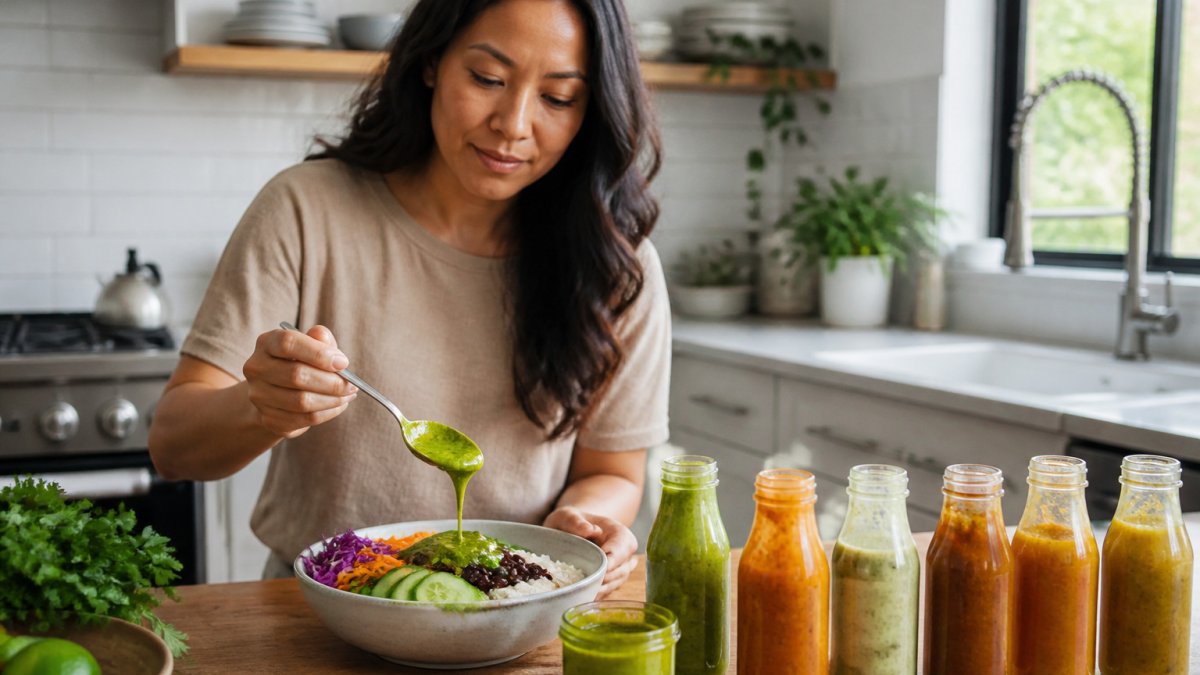
A home cook in a bright kitchen spooning green sauce over rice and vegetables shows the everyday use these bottles are built for, but the better test is to think about your own cooking patterns. If you grill often, start with the Chimichurri. If you make tacos and sandwiches weekly, the Peruvian Verde earns its place. If stir-fries and curries are your default, the Coconut Yellow Curry and the Asian stir-fry set are the practical picks. Browse the Asian sauce bundle and Grilling 3 Pack to match flavors to the meals you already make, and check each label for soy and sugar if those are limits for you.
How to Store Artisanal Vegan Sauces and Choose Your First Bundle
Storage advice varies by product, so read the label on each bottle rather than assuming a single rule. Keep opened sauces sealed, store them away from heat, and follow the storage instructions printed on the packaging. Many home cooks find that a smaller first purchase lets them learn how a flavor fits their cooking before committing to more bottles.
When you pick a first bundle, start with the cuisine you cook most and the allergens you need to avoid. If you are unsure where to begin, read our storage and bundle guide before you order, then browse the bundle and save offers.
Small batch sauces are worth the cost when the ingredient list, allergen controls, and flavor match your cooking. They are harder to justify if you need the cheapest possible condiment for everyday use. Weigh the cost per ounce, read the labels, and buy the flavors you will actually finish.
Frequently Asked Questions
Are small batch sauces worth the extra cost?
For many home cooks, yes, but it depends on how often you cook and what you need from a sauce. MOB Sauce sauces are hand-filled in small batches, are gluten-free certified, and contain no canola oil. The Sweet Chili Lemongrass Sauce is $12.00, and the sauce trios are $33.00.
What makes small-batch sauces different from mass-produced sauces?
At MOB Sauce, sauces are hand-filled in small batches, with small-batch tasting for quality control.
How should you store artisanal sauces after opening?
MOB Sauce products are plant-based and free of dairy and eggs.
Which small-batch sauces are best for everyday cooking?
The Asian Sauce Bundle is listed for stir-fries, dressings, marinades, and dipping, and contains a small amount of cane sugar. The Coconut Yellow Curry Sauce is listed for rice and noodle bowls, seafood, and stir-fry. The Chilean Chimichurri can be used as a dressing, over roasted vegetables, or as a bread dip. The Peruvian Verde Sauce is cilantro-forward with a lime finish and is listed for tacos, pulled pork, sandwiches, or as a dressing. The Top Rated Sauce Bundle includes the Curry, Chimichurri, and Verde.

