
Quick Summary
Gluten free sauces for Asian cooking are easiest to find by choosing tamari instead of standard soy sauce, and by checking for a third-party certification seal such as GFCO or NSF. Conventional soy sauce, teriyaki and hoisin usually contain wheat, so the label must be read every time.
- Traditional soy sauce is brewed with wheat, so a standard bottle carries gluten.
- Tamari is usually the better starting point, but some brands add wheat, so check the label.
- Use tamari 1:1 for soy sauce, and reduce added salt by about a quarter.
- A certification seal is stronger than a gluten-free claim alone.
- Check each product for soy, since many certified gluten-free sauces contain soy.
Table of Contents
- Why Most Asian Sauces Contain Gluten
- Gluten-Free Soy Sauce and Tamari: What to Look For
- Gluten-Free Teriyaki Sauce Options and Substitutes
- Gluten-Free Stir-Fry Sauce for Weeknight Cooking
- Gluten-Free Hoisin Sauce and Where It Hides
- Checking Labels for Gluten, Soy and Cross-Contamination
- Choosing Your Gluten-Free Asian Sauce Lineup
- Frequently Asked Questions
Gluten-Free Sauces for Asian Cooking: A Buyer's Guide
Last Updated: October 30, 2026
Why Most Asian Sauces Contain Gluten
Most questions about finding gluten free sauces start in the same place: the bottle in the pantry says "soy sauce" and nothing else, and that is where the trouble begins. Traditional soy sauce is brewed with wheat, so a standard bottle carries gluten even though soy is a legume. Teriyaki, hoisin and many stir-fry sauces inherit the same problem, often through wheat-based thickeners or fermented wheat ingredients. Confusion like this is common, which is why clear labeling and third-party gluten-free certification matter.
The practical lesson is simple: assume a conventional Asian sauce contains gluten until the label proves otherwise. A quick scan of the ingredient list catches wheat, barley and malt. A certification seal is the stronger signal, because it means the product was checked, not just described.
Gluten-Free Soy Sauce and Tamari: What to Look For
Tamari is the most common swap for soy sauce, and it is usually the better starting point when you are shopping for gluten free sauces for home cooking. It is traditionally brewed with little or no wheat, though formulations vary, so the label remains the final authority. Look for the words "gluten-free" on the front of the bottle and check whether the product is certified.
Watch out: a bottle labeled "tamari" is not automatically gluten-free. Some brands add wheat, so read the back of the bottle every time you buy.
Flavor is the other consideration. Tamari tends to be slightly richer and less sharp than standard soy sauce, which many cooks prefer in stir-fries. Use it at the same ratio you would use soy sauce, then taste before adding salt.
Gluten-Free Teriyaki Sauce Options and Substitutes
Teriyaki is one of the hardest sauces to find gluten-free on a standard shelf, because most versions rely on soy sauce and wheat-based thickeners. The most reliable approach is to choose a sauce made without those ingredients from the start, or to build your own with a ratio you can repeat.
Store-bought options. Look for teriyaki labeled gluten-free and carrying a third-party seal (GFCO or NSF Certified Gluten-Free). Many gluten-free teriyaki sauces use tamari in place of soy sauce and a gluten-free starch, usually tapioca, arrowroot, or cornstarch, in place of wheat flour. Check the allergen statement for soy, since tamari is soy-based, and check for sesame if that is a concern.
A repeatable homemade ratio. For about 1/2 cup of teriyaki-style glaze, combine:
- 1/4 cup gluten-free tamari
- 3 tablespoons mirin (check the label, some mirin contains no gluten, but verify)
- 1 to 2 tablespoons coconut sugar, maple syrup, or another sweetener, to taste
- 1 tablespoon rice vinegar
- 1 teaspoon grated fresh ginger
- 1 small garlic clove, grated
- 1 teaspoon gluten-free cornstarch or arrowroot dissolved in 1 tablespoon cold water
Simmer the tamari, mirin, sweetener, vinegar, ginger, and garlic for 2 to 3 minutes, then whisk in the starch slurry and cook 30 to 60 seconds until it coats a spoon. The ratio is forgiving: more sweetener pushes it toward a glaze, more vinegar sharpens it, and more starch thickens it.
Substitution ratios when a recipe calls for conventional teriyaki. Replace conventional teriyaki with gluten-free teriyaki at a 1:1 ratio by volume. If you are swapping in tamari alone, use it 1:1 for soy sauce but reduce any added salt in the recipe by about a quarter, because tamari is often slightly saltier and more concentrated.
Flavor adjustments. Teriyaki balances salty, sweet, and bright. If your gluten-free version tastes flat, add a splash of rice vinegar or a squeeze of fresh lime. If it tastes too salty, dilute with a tablespoon of water or unsweetened pineapple juice rather than adding more sweetener. If it is too thin, simmer it briefly or add a small amount of starch slurry off the heat.
Our Sweet Chili Lemongrass Sauce is not a teriyaki. It is vegan, certified gluten-free and certified nut-free. It also contains soy, so it is not suitable for readers avoiding soy. For a nutty, roasted alternative to hoisin that is nut-free, see Sesame Satay Sauce. Check the product page for full details: Sweet Chili Lemongrass Sauce.


Here is a quick reference for the teriyaki glaze ratios and substitution rules covered above.
| Item | Value | Note |
|---|---|---|
| Tamari for soy sauce | 1:1 by volume | Reduce added salt by about a quarter |
| Gluten-free teriyaki for teriyaki | 1:1 by volume | Check for soy and sesame |
| Stir-fry sauce in place of teriyaki | Start at 3/4 of amount | Taste, since sweetness varies |
| Homemade glaze tamari | 1/4 cup | Makes about 1/2 cup glaze |
| Starch slurry | 1 tsp starch + 1 tbsp cold water | Whisk in off the heat |
Gluten-Free Stir-Fry Sauce for Weeknight Cooking
A good gluten-free stir-fry sauce should coat vegetables and protein without turning gummy or overly sweet. The fastest route is to pick a ready-made base and finish it at the end of cooking. Our Coconut Yellow Curry Sauce can be added to the pan near the end of cooking. It is certified gluten-free, soy-free and nut-free, and it works as a simmer sauce or finishing sauce for rice and noodle bowls.
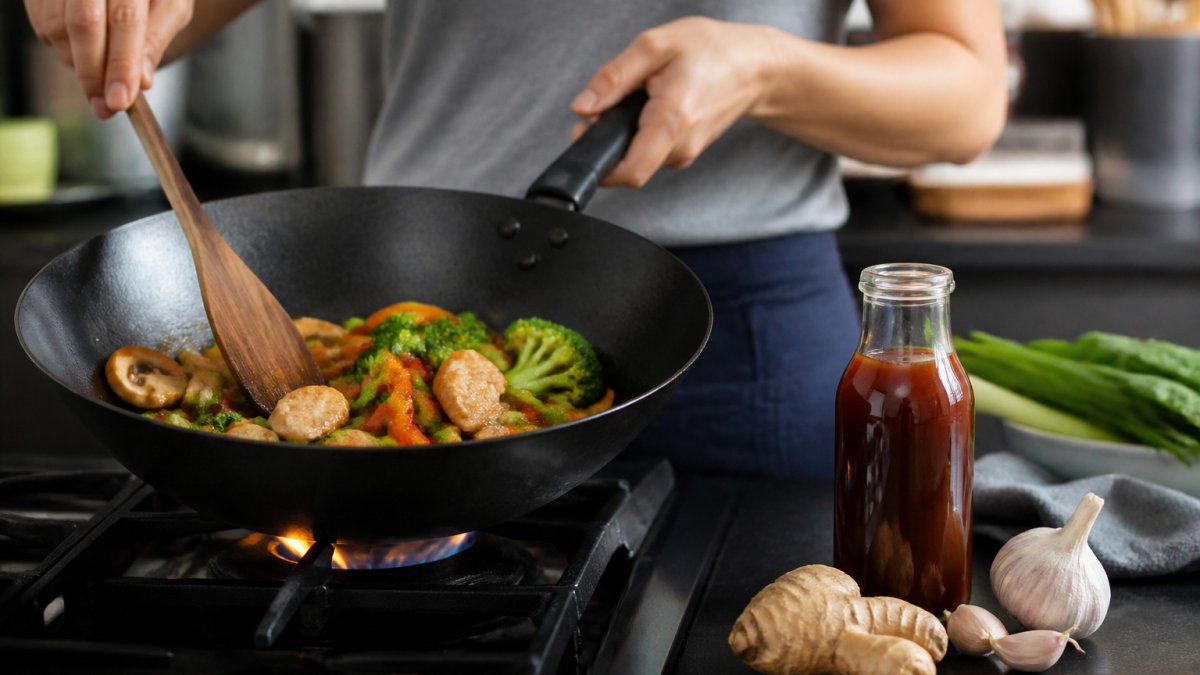
Home cook tossing vegetables and chicken in a wok over a stove, a small glass bottle of sauce on the counter beside fresh ginger and garlic.
MOB Sweet Chili Lemongrass Sauce →
Keep in mind that the curry sauce should be used within one month of opening, and refrigeration can thicken it. Warming the bottle briefly in warm water will loosen it for pouring.
Gluten-Free Hoisin Sauce and Where It Hides
Hoisin is thick, sweet and fermented, and conventional versions typically include wheat. It also shows up in unexpected places, such as marinades, dipping blends and some barbecue-style glazes. When a recipe calls for hoisin, read the full ingredient list of every component, not just the main sauce.
For a similar depth of flavor without the gluten, our Sesame Satay Sauce brings a roasted, nutty richness through toasted sesame oil and tahini. It is certified gluten-free and nut-free, though it contains tamari, so it is not soy-free. It works well as a glaze, a dip for egg rolls, or a thinned dressing for noodles.
Checking Labels for Gluten, Soy and Cross-Contamination
Reading labels is the core skill in gluten-free Asian cooking, but "read the label" is not enough on its own. The goal is to separate a verified gluten-free product from one that merely avoids obvious wheat ingredients. A practical checklist works better than a single glance.
Step 1: Look for a certification seal, not just a claim. In the United States, the most common third-party seals are the Gluten-Free Certification Organization (GFCO) mark, which requires testing to 10 parts per million, and NSF Certified Gluten-Free, which tests to 20 ppm. In Canada, look for the Canadian Celiac Association's gluten-free certification mark. A product labeled "gluten-free" without a seal may still be compliant with FDA rules (which require less than 20 ppm), but a seal means an outside body verified it. For celiac disease, the seal is the stronger signal.
Step 2: Read the full ingredient list for hidden wheat. Beyond the word "wheat," scan for barley, rye, malt, malt extract, malt vinegar, brewer's yeast, and "modified food starch" when the source is not specified. Soy sauce, teriyaki, hoisin, oyster sauce, and many stir-fry bases routinely contain one or more of these. A "wheat-free" label is not the same as gluten-free, it says nothing about barley or rye.
Step 3: Check the allergen statement separately from the ingredient list. In the U.S., wheat is a major allergen and must be declared, but barley and rye are not, so they can appear only in the ingredient list. A product can be wheat-free and still contain barley malt. Read both panels.
Step 4: Evaluate cross-contamination language. For celiac disease and severe sensitivity, shared equipment matters. Look for phrases like "produced in a dedicated gluten-free facility," "made on equipment that also processes wheat," or "facility also handles wheat." The first is the strongest; the second and third are cautions. If the package says nothing, contact the manufacturer and ask two specific questions: (1) Is the product tested for gluten, and at what threshold? (2) Is it run on shared lines with wheat-containing products, and is there a validated allergen cleaning protocol between runs?
Step 5: Re-check on every repurchase. Formulations change without notice. A sauce that was certified last year may have reformulated, changed suppliers, or dropped a certification. Photograph the label or note the lot code when you find a product that works, and re-verify the seal and ingredient list the next time you buy.
For restaurant and shared-kitchen cooking, the same logic applies to preparation: ask whether the kitchen uses a dedicated gluten-free wok, separate fryer oil, and clean utensils, and whether sauces are ladled from closed containers rather than shared bowls. Cross-contamination in a kitchen is often a handling problem, not an ingredient problem.
Choosing Your Gluten-Free Asian Sauce Lineup
Start with the dishes you cook most often, then pick one sauce for each main role: a dipping sauce, a stir-fry finish and a marinade. A lineup of three well-chosen sauces covers most weeknight meals without a crowded fridge.
Our Asian Sauce Bundle includes a set of low-sugar stir-fry sauces. Note that the bundle contains a small amount of cane sugar and gluten-free tamari, so check it against your own soy and sugar limits. You can view the bundle here: Asian Sauce Bundle.

For readers who need to avoid soy entirely, look for products clearly marked soy-free and check the full list before you buy. Our Coconut Yellow Curry Sauce is labeled soy-free. Browse the full range to find the flavor profile that fits your kitchen.
Frequently Asked Questions
Can people with celiac disease eat Kikkoman soy sauce?
Standard Kikkoman soy sauce is brewed with wheat, so it is not safe for people with celiac disease. Look for a sauce labeled gluten-free or certified gluten-free, or use tamari, which is usually made with little or no wheat. Always read the current label, because recipes can change, and check for a certification mark rather than relying on the product name alone. MOB Asian Sauce Bundle includes gluten-free tamari, so check its label details before serving it to someone with celiac disease.
Is tamari always gluten-free?
No. Tamari is traditionally made with little or no wheat, but some brands add wheat or are processed on shared lines, so tamari is not automatically gluten-free. Check the label for a gluten-free claim or certification. The MOB Sesame Satay Sauce is certified gluten-free and uses tamari, but it is still worth confirming the label on the bottle you buy.
What is a gluten-free alternative to teriyaki sauce?
A gluten-free teriyaki substitute usually swaps regular soy sauce for tamari or a certified gluten-free soy sauce, then keeps the sweetness and thickness balanced. The MOB Sweet Chili Lemongrass Sauce is certified gluten-free and works as a marinade and dipping sauce, though its flavor is brighter and less sweet than teriyaki. Expect a different taste.
How can I make a gluten-free stir-fry sauce at home?
Combine tamari or gluten-free soy sauce with rice vinegar, a small amount of sugar, grated ginger and garlic, and a cornstarch slurry to thicken it. Add the sauce at the end of cooking so the flavor stays bold. If you want a ready-made option, MOB Coconut Yellow Curry Sauce is certified gluten-free and can be added at the end of a stir-fry for a finished flavor.

