
Table of Contents
- Why Avoid Canola Oil in Cooking
- Understanding Canola Oil Health Risks
- Industrial Processing and Refinement
- Canola Oil Smoke Point and Cooking Performance
- Canola Oil vs Olive Oil: A Practical Comparison
- Better Canola Oil Alternatives for Your Kitchen
- Making the Switch: Practical Cooking Guidance
- Frequently Asked Questions
Last Updated: October 14, 2026
Why Avoid Canola Oil in Cooking
When you're trying to eat healthier, the oils you choose matter. Canola oil has become a kitchen staple, but it comes with real drawbacks that are worth understanding. We've examined the research on canola oil health risks, and the picture is more complex than most cooking guides suggest.
The main concern isn't that canola oil will harm you overnight. It's that regular use of highly refined seed oils shifts your diet in ways that many health-conscious cooks want to avoid. At MOB Sauce, we focus on clean-label ingredients precisely because we believe transparency about what goes into your food matters.
Understanding why some people choose to avoid canola oil helps you make the right decision for your kitchen and your family.
Understanding Canola Oil Health Risks
Canola oil's fatty-acid profile is the starting point for most health concerns. The oil is high in omega-6 polyunsaturated fats and relatively low in omega-3 fatty acids. This matters because your body needs both, but the ratio between them affects inflammation markers.
Many people consume far more omega-6 than omega-3 in modern diets. When you add canola oil to that imbalance, you're pushing the ratio even further. A typical Western diet already leans heavily toward omega-6, so choosing oils with better omega-3-to-omega-6 ratios makes practical sense if you're trying to reduce pro-inflammatory patterns.
Fatty-Acid Profile and Omega Imbalance
Canola oil contains roughly 20% alpha-linolenic acid (an omega-3) and 20% linoleic acid (an omega-6). The remaining 60% is oleic acid, a monounsaturated fat. This composition means canola oil is not inherently unhealthy, but it's not optimal if you're already consuming excess omega-6 from other sources.
The omega-3 content sounds good on paper. However, alpha-linolenic acid requires conversion to EPA and DHA in your body, and that conversion is inefficient. You don't get the direct omega-3 benefits you'd get from fish, flax seeds, or chia seeds. Meanwhile, the omega-6 content contributes to the imbalance that concerns many health practitioners.
If your goal is to support gut health and immune system function, managing your omega-3-to-omega-6 ratio is one lever you can control. Swapping canola oil for alternatives with better ratios is a simple way to shift that balance.
Oxidation and High-Heat Cooking
Here's where canola oil's chemistry becomes relevant to your cooking choices. Polyunsaturated fats like those in canola oil are susceptible to oxidation when heated (Vegetable oil oxidation). Oxidation creates compounds called oxidized linoleic acid metabolites (OXLAMs), which some early research suggests may trigger inflammation responses in the gut.
High-heat cooking accelerates this process. When you use canola oil for frying, sautéing at high temperatures, or reusing oil (which many home cooks do), oxidation happens faster. The longer the oil sits at high temperatures, the more oxidized it becomes.
This is not unique to canola oil, but it's worth considering when you're choosing which oil to use for which cooking method. Some oils handle heat better than others, and that practical difference affects both safety and nutrition. Maintaining the integrity of your cookware is just as vital as selecting the right fat, as even the most stable oil can become problematic when used on compromised safe cooking surfaces.
Industrial Processing and Refinement
Canola oil starts as a seed that goes through significant processing before it reaches your kitchen. Understanding this process helps explain why some cooks prefer alternatives.
The refining process involves several steps. Seeds are crushed, heated to high temperatures, treated with chemicals, and then bleached and deodorized. This industrial processing removes impurities but also removes some of the oil's natural compounds. The end result is a neutral-tasting, shelf-stable product that works in many recipes.
The concern isn't that refined canola oil is dangerous. It's that the processing removes compounds that might have nutritional value. If you're looking for less processed options, cold-pressed oils retain more of their original chemistry. Cold-pressed canola oil exists but is rare and more expensive than refined versions.
At MOB Sauce, we prioritize transparent sourcing and minimal processing in our ingredient choices because we believe consumers deserve to know what's actually in their food. That same philosophy applies to the cooking oils you choose for your kitchen.
Canola Oil Smoke Point and Cooking Performance
Smoke point is the temperature at which an oil visibly breaks down and releases acrolein and other volatile compounds. Refined canola oil smokes around 400°F (204°C). That number is useful, but it's not the whole story, oxidative stability, how long the oil is held at temperature, and whether it's reused matter just as much. Here's how canola actually performs across real cooking methods.
Method-by-method guidance
Salad dressings, dips, and finishing (no heat). Canola works, but it's a wasted opportunity. Extra virgin olive oil, walnut oil, or sesame oil add flavor and, in the case of EVOO, polyphenols. If you're avoiding canola, this is the easiest swap.

Baking (325-375°F). Canola is a common baking oil because its neutral flavor doesn't compete with vanilla or chocolate. It performs fine here. If you want to replace it, melted coconut oil, avocado oil, or a mild olive oil (not extra virgin) all work in most cake, muffin, and quick-bread recipes. Expect slight texture differences with coconut oil in cold applications.
Sautéing and pan-frying (medium to medium-high, roughly 325-375°F). Canola is at the edge of its comfort zone. It will perform, but if you're searing at the top of that range or cooking in batches for 20+ minutes, the oil is degrading as you cook. Extra virgin olive oil actually holds up better here than its smoke point suggests, because its polyphenols slow oxidation. Avocado oil is the most stable choice.
Deep frying (350-375°F). Canola is widely used for frying because it's cheap and neutral. The problem is reuse. Each heating cycle oxidizes more of the oil, and repeated frying at 375°F produces measurable increases in polar compounds and aldehydes. If you fry, use fresh oil, keep the temperature at the lower end of the range, filter between uses, and discard after two or three cycles. High-oleic oils (avocado, high-oleic sunflower, high-oleic safflower) resist breakdown longer.
Searing and stir-frying (400°F+). This is where canola is the wrong tool. A ripping-hot cast-iron sear or a wok stir-fry pushes refined canola past its smoke point quickly. Use avocado oil (smoke point ~500°F), refined coconut oil, or a high-oleic oil instead.
Oxidation, storage, and reuse
Polyunsaturated fats, including the linoleic acid and ALA in canola, are the most prone to oxidation. Heat accelerates it, light accelerates it, and oxygen accelerates it. Three practical rules:
- Store oil dark and cool. A closed cabinet beats a windowsill. A dark bottle beats a clear one. Refrigeration extends shelf life for oils you use slowly.
- Don't reuse frying oil indefinitely. A common home pattern is to keep a fryer or a pan of oil going for weeks. That oil is accumulating oxidation products with every cycle. Two to three uses is a reasonable ceiling for home frying.
- Watch for the signs. Rancid oil smells like crayons or old nuts, looks darker, and foams more when heated. If it smells off, it is off.
When to choose another oil
| Cooking task | Canola OK? | Better choice |
|---|---|---|
| Salad dressing | Yes, but bland | Extra virgin olive oil |
| Baking | Yes | Avocado oil, melted coconut oil |
| Medium sauté | Yes | Extra virgin olive oil, avocado oil |
| Deep frying (fresh oil) | Yes | High-oleic sunflower, avocado oil |
| Deep frying (reused oil) | No | Discard and start fresh |
| High-heat sear / wok | No | Avocado oil, refined coconut oil |
USDA FoodData Central, canola oil fatty-acid composition
Canola Oil vs Olive Oil: A Practical Comparison
Most comparisons of canola and olive oil stop at smoke point and a fatty-acid table. That's not enough to make a real kitchen decision, because the two oils differ in processing, polyphenol content, oxidative stability, and how they behave across cooking methods. Here's a claim-by-claim look, with an honest read on evidence quality.
Black Garlic Extra Virgin Olive Oil →
What the evidence actually supports
Fatty-acid profile, established. Extra virgin olive oil is roughly 70-80% monounsaturated fat (mostly oleic acid), with small amounts of polyunsaturated fat. Refined canola oil is about 60% monounsaturated, 20% omega-6 linoleic acid, and 8-12% omega-3 alpha-linolenic acid (ALA). Olive oil wins on monounsaturated content; canola wins on ALA content. Both are low in saturated fat compared with coconut oil or butter.
Polyphenols, established, but only for extra virgin olive oil. Extra virgin olive oil contains phenolic compounds such as hydroxytyrosol and oleuropein, which have antioxidant activity in laboratory and human studies. Refined olive oil and virtually all refined canola oil lose most of these compounds during deodorization. If polyphenols are your priority, the relevant comparison is extra virgin olive oil vs. cold-pressed canola, not the refined bottle on most grocery shelves.
Heart-health outcomes, established for olive oil, weaker for canola. Large observational studies and randomized trials (notably PREDIMED) link Mediterranean-style diets rich in extra virgin olive oil with lower cardiovascular risk. Canola oil has been studied for LDL-lowering effects, and replacing saturated fat with canola does lower LDL in controlled feeding trials, but the outcome evidence is thinner than for olive oil. This is a difference in evidence quality, not proof that canola is harmful.
Inflammation and omega ratios, mixed and often overstated. The claim that canola oil drives inflammation because of its omega-6 content is not well supported by human trials at typical dietary intakes. Linoleic acid is an essential fatty acid, and controlled studies have not consistently shown that higher linoleic acid intake raises inflammatory markers. What is better supported is that very high omega-6 relative to omega-3 is a pattern worth correcting, but the fix is usually eating more fatty fish, not eliminating one cooking oil.
Oxidation at high heat, established, but method-dependent. Both oils oxidize when heated past their stability limits. Extra virgin olive oil is more resistant to oxidation than its smoke point suggests, thanks to its polyphenols. Refined canola is more stable than unrefined oils but degrades with repeated high-heat use. The practical variable is not the oil's label, it's how long and how hot you heat it.
Side-by-side, with the caveats that matter
| Factor | Refined Canola Oil | Extra Virgin Olive Oil |
|---|---|---|
| Smoke point | ~400°F (204°C) | ~350-410°F depending on quality |
| Monounsaturated fat | ~60% | ~70-80% |
| Omega-3 ALA | ~8-12% | <1% |
| Polyphenols | Stripped by refining | Retained in EVOO |
| Flavor | Neutral | Distinct, varies by origin |
| Best evidence for heart outcomes | Moderate | Strong (PREDIMED, Mediterranean diet research) |
| Cost | Lower | Higher |
| Best cooking uses | Neutral baking, moderate sauté | Dressings, finishing, low-to-medium heat |
How to choose without overthinking it
If your goal is cardiovascular risk reduction and you can afford it, extra virgin olive oil is the better-documented everyday choice for dressings, finishing, and low-to-medium heat cooking. If your goal is a neutral, affordable oil for baking or moderate sautéing, refined canola is functional, but it's not the only option, and it isn't a nutritional upgrade over olive oil.
A common pattern among people who avoid canola is to keep two oils on hand: an extra virgin olive oil for flavor and polyphenols, and a high-oleic oil (avocado or high-oleic sunflower) for higher-heat work. That covers most home cooking without relying on any single oil.
PREDIMED trial summary and Mediterranean diet cardiovascular outcomes
Better Canola Oil Alternatives for Your Kitchen
If you're looking to replace canola oil, several alternatives offer better nutritional profiles or different cooking properties. The best choice depends on how you cook and what your priorities are.
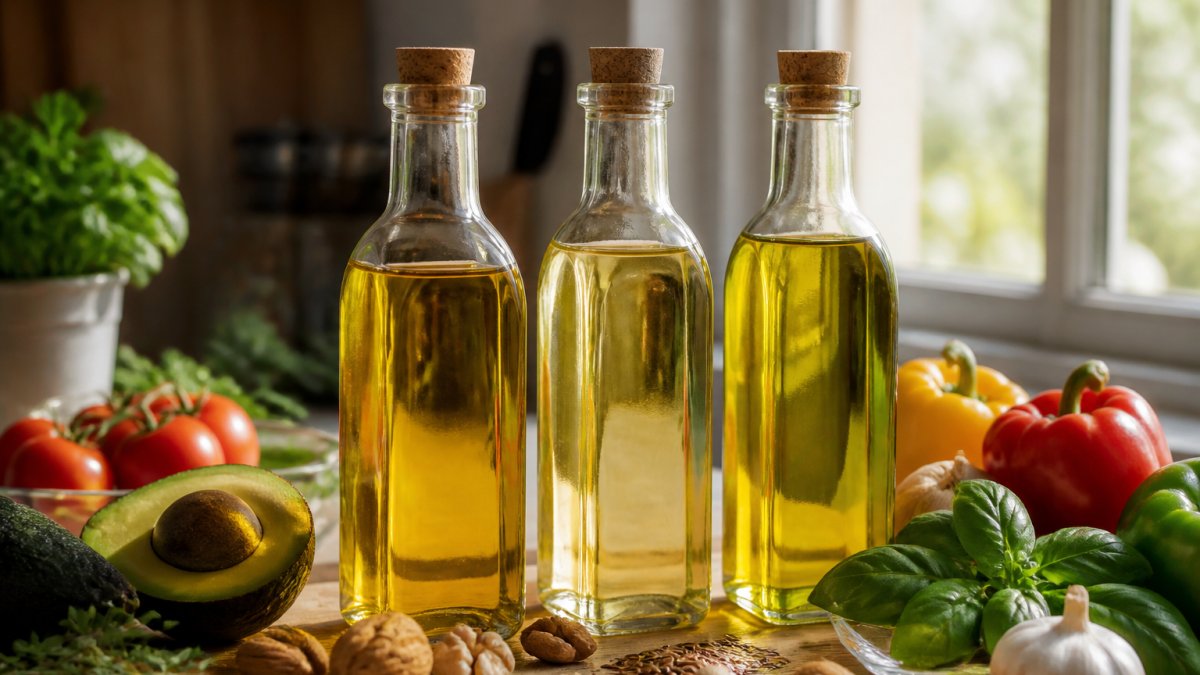
Extra Virgin Olive Oil
Extra virgin olive oil is minimally processed and retains polyphenols, which act as antioxidants in your body. The fatty-acid profile is superior to canola oil, with higher monounsaturated fats and a better omega-3-to-omega-6 balance.
The downside is that extra virgin olive oil has a lower smoke point, so you can't use it for high-heat cooking. It's best for salad dressings, dipping, or finishing dishes. Our Black Garlic Extra Virgin Olive Oil offers this same benefit with added umami depth from black garlic, making it ideal for dressings or as a finishing oil over vegetables and salads.
Avocado Oil
Avocado oil has a higher smoke point (around 500°F) than both canola and olive oil, making it suitable for high-heat cooking. It's also rich in monounsaturated fats and contains lutein, an antioxidant that supports eye health.
The trade-off is cost. Avocado oil is more expensive than canola oil, so it's a premium choice for cooks who prioritize heat stability and nutrition. For searing, stir-frying, and high-heat cooking, avocado oil outperforms canola oil on nearly every metric.
Coconut Oil
Coconut oil is primarily saturated fat, which makes it stable at high temperatures and resistant to oxidation. It has a distinct flavor that works well in certain cuisines but not in others.
The saturated fat content is higher than canola oil, which some people view as a drawback for heart health. However, the stability at high heat and resistance to oxidation make it a good choice for frying if you're willing to accept the flavor profile.
Making the Switch: Practical Cooking Guidance
Switching away from canola oil doesn't mean overhauling your entire kitchen. Start by matching oils to cooking methods, then gradually replace canola oil as you use it up.
For salad dressings and finishing: Replace canola oil with extra virgin olive oil. The flavor improvement is immediate, and the nutritional benefits are clear.
For high-heat cooking: Use avocado oil if budget allows. If not, refined coconut oil or refined olive oil are solid alternatives with better heat stability than canola oil.
For everyday cooking at moderate temperatures: You have options. Olive oil works fine. Avocado oil is better. Even refined coconut oil is more stable.
The practical reality is that no single oil is ideal for every cooking task. Professional kitchens use multiple oils because each one has strengths. You don't need to buy five different oils, but having two or three suited to different purposes beats relying on one oil for everything.
Choosing what goes into your food matters. When you're managing dietary restrictions or simply prioritizing cleaner ingredients, the oils you cook with deserve the same attention as everything else. If you're already avoiding processed additives and looking for sauces that match that commitment, MOB Sauce offers plant-based, vegan options crafted in small batches without canola oil. Our sauces are nut-free, gluten-free certified, and designed for cooks who care about what's actually in their food. Shop All Sauces and discover bold, global flavors that align with your clean-eating goals.
Frequently Asked Questions
Is canola oil bad for cooking?
Canola oil presents concerns for regular cooking due to its fatty-acid composition and oxidation behavior at high temperatures. The omega-6-to-omega-3 ratio in canola oil is skewed toward omega-6, which some research suggests may promote inflammation when consumed in excess. Additionally, canola oil's smoke point is moderate (around 400°F), making it less stable during high-heat frying compared to alternatives like avocado oil. For most home cooks, avoiding canola oil means choosing oils with better heat stability or more balanced fatty-acid profiles.
What are the main canola oil health risks?
The primary canola oil health risks include oxidation during cooking, which produces compounds that may stress the immune system and gut health; an unfavorable omega-3-to-omega-6 ratio that some evidence links to pro-inflammatory effects; and concerns about highly refined processing methods that strip the oil of natural compounds. Individual responses vary based on total dietary fat intake and overall diet quality.
What can I use instead of canola oil in cooking?
Extra virgin olive oil works well for low- to medium-heat cooking and dressings, offering better fatty-acid balance and antioxidants. Avocado oil has a higher smoke point (around 520°F) and suits high-heat cooking and frying. Coconut oil provides saturated fats and works for baking or medium-heat applications. For those seeking clean-label options without seed oils, MOB Sauce's Black Garlic Extra Virgin Olive Oil offers a ready-made alternative for dressings, dips, and finishing dishes while avoiding canola oil entirely. Choose based on your cooking temperature and flavor profile needs.
How does canola oil's smoke point affect cooking safety?
Canola oil has a smoke point around 400°F, making it unsuitable for high-heat frying or searing. When oils exceed their smoke point, they break down and oxidize, releasing potentially harmful compounds. Avocado oil (520°F) and refined coconut oil (450°F) offer better heat stability. For everyday cooking, matching your oil choice to your cooking method, low-heat sautéing with olive oil, high-heat frying with avocado oil, ensures both safety and nutritional integrity. Using an oil beyond its smoke point also degrades flavor and nutritional value.